The standards are evolving, expectations are becoming more rigorous, and training programs need to start preparing now for the new ICF requirements.
Three Major Changes That Will Transform Current Practice
1. From Summative Assessment to Formative Assessment: Supporting Rather Than Judging
The traditional approach, based on evaluating a single coaching session, is gradually giving way to a more comprehensive view of a coach's development.
The new model emphasizes:
-
ongoing support over time;
-
regular, documented formative feedback;
-
observing the coach's development across multiple coaching sessions;
-
improved documentation and traceability of the coach's professional growth.
The mentor thus becomes a true developmental partner, helping coaches deepen their understanding and integration of the ICF Core Competencies.
2. The Introduction of the Mentor Coach Specialization (MCS): A New Professional Standard
The ICF now officially recognizes mentor coaching as a professional specialization in its own right. The role of the Mentor Coach requires a new set of specialized competencies, including:
-
an in-depth understanding of the ACC, PCC, and MCC standards;
-
the ability to accurately observe coaching behaviors;
-
mastery of formative feedback and the coach's progressive development;
-
heightened awareness of biases that may influence observation and feedback.
Starting in 2027, all mentor coaching delivered within ICF-accredited training programs must be provided by a recognized Mentor Coach Specialist (MCS) who is listed in the official ICF registry.
The standard pathway to this recognition requires completion of a 41-hour accredited training program.
However, the ICF has also established an accelerated 10-hour pathway for two categories of experienced professionals:
-
assessors and/or mentors who have served within an ICF-accredited coach training program;
-
independent mentor coaches who can demonstrate that they have mentored at least five coaches who obtained an ICF credential during the previous three years.
3. The Introduction of the Coaching Supervisor Specialization (CSS)
The ICF is taking another significant step in the professionalization of coaching with the creation of the Coaching Supervisor Specialization (CSS), an official specialization dedicated to coaching supervision. This recognition clearly distinguishes coaching supervision from mentor coaching and establishes it as a professional discipline in its own right.
Coaching supervision is presented as a key driver of professional development, fostering reflective practice, quality of coaching, ethical awareness, and the coach's overall well-being.
To obtain the CSS, candidates must:
-
hold an ICF PCC or MCC credential;
-
complete a specialized training program of at least 41 hours, with a minimum of 50% delivered synchronously;
-
demonstrate proficiency in the new ICF Coaching Supervision Competencies.
Certified Coaching Supervisors will be listed in an official ICF registry and will receive a digital badge recognizing their qualification.
With this initiative, the ICF continues its strategy of creating professional specializations within the coaching profession, following the introduction of the Mentor Coach Specialization (MCS).
From now on:
-
the Mentor Coach supports the development of coaching competencies in alignment with the ICF competency framework;
-
the Coach Supervisor supports reflective practice, ethics, professional presence, and the coach's overall professional development.
This evolution represents another important milestone in strengthening the maturity, professionalism, and international credibility of the coaching profession.
----
De standaarden evolueren, de verwachtingen worden strenger en opleidingsprogramma's moeten zich nu al voorbereiden op de nieuwe ICF-vereisten.
Drie belangrijke veranderingen die de huidige praktijk zullen transformeren
1. Van Summative Assessment naar Formative Assessment: begeleiden in plaats van beoordelen
De traditionele benadering, gebaseerd op de beoordeling van één enkele coachingsessie, maakt geleidelijk plaats voor een meer integrale visie op de ontwikkeling van de coach.
Het nieuwe model legt de nadruk op:
-
voortdurende begeleiding over een langere periode;
-
regelmatige en gedocumenteerde formatieve feedback;
-
observatie van de ontwikkeling van de coach over meerdere coachingsessies;
-
betere documentatie en traceerbaarheid van de professionele ontwikkeling van de coach.
De mentor wordt daarmee een echte ontwikkelingspartner, die de coach helpt een diepgaander begrip en integratie van de ICF Core Competencies te ontwikkelen.
2. De introductie van de Mentor Coach Specialization (MCS): een nieuwe professionele standaard
De ICF erkent mentor coaching voortaan officieel als een professionele specialisatie. De rol van Mentor Coach vraagt om een nieuw pakket aan specifieke competenties, waaronder:
-
een grondige kennis van de ACC-, PCC- en MCC-standaarden;
-
het vermogen om coachgedrag nauwkeurig te observeren;
-
beheersing van formatieve feedback en de stapsgewijze ontwikkeling van de coach;
-
een verhoogd bewustzijn van mogelijke vooroordelen (biases) die observatie en feedback kunnen beïnvloeden.
Vanaf 2027 moet alle mentor coaching binnen ICF-geaccrediteerde opleidingsprogramma's worden verzorgd door een erkende Mentor Coach Specialist (MCS) die is opgenomen in het officiële ICF-register.
De standaardroute naar deze erkenning bestaat uit een geaccrediteerde opleiding van 41 uur.
Daarnaast voorziet de ICF in een versnelde route van 10 uur voor twee categorieën ervaren professionals:
-
assessoren en/of mentoren die werkzaam zijn geweest binnen een door de ICF geaccrediteerd coachopleidingsprogramma;
-
onafhankelijke mentor coaches die kunnen aantonen dat zij in de afgelopen drie jaar ten minste vijf coaches hebben begeleid die een ICF-credential hebben behaald.
3. De introductie van de Coaching Supervisor Specialization (CSS)
De ICF zet opnieuw een belangrijke stap in de professionalisering van het coachvak met de introductie van de Coaching Supervisor Specialization (CSS), een officiële specialisatie die volledig is gericht op coachsupervisie. Deze erkenning maakt een duidelijk onderscheid tussen coachsupervisie en mentor coaching en geeft supervisie een eigen professionele status.
Coachsupervisie wordt gepresenteerd als een belangrijke motor voor professionele ontwikkeling. Zij stimuleert reflectieve praktijk, de kwaliteit van coaching, ethisch handelen en het welzijn van de coach.
Om de CSS te behalen moeten kandidaten:
-
beschikken over een ICF PCC- of MCC-credential;
-
een gespecialiseerde opleiding volgen van minimaal 41 uur, waarvan ten minste 50% synchroon wordt verzorgd;
-
aantonen dat zij de nieuwe ICF Coaching Supervision Competencies beheersen.
Gecertificeerde Coaching Supervisors worden opgenomen in een officieel ICF-register en ontvangen een digitale badge die hun kwalificatie bevestigt.
Met dit initiatief zet de ICF haar strategie voort om verdere professionele specialisaties binnen het coachvak te ontwikkelen, na de introductie van de Mentor Coach Specialization (MCS).
Voortaan geldt:
-
de Mentor Coach ondersteunt de ontwikkeling van coachcompetenties volgens het ICF-competentiekader;
-
de Coach Supervisor ondersteunt reflectie op de praktijk, ethiek, professionele aanwezigheid (presence) en de algehele professionele ontwikkeling van de coach.
Deze ontwikkeling markeert opnieuw een belangrijke stap in het versterken van de volwassenheid, professionaliteit en internationale geloofwaardigheid van het coachvak.
-----
Les standards évoluent, les attentes se renforcent et les programmes de formation doivent dès maintenant se préparer aux nouvelles exigences de l’ICF.
Trois évolutions majeures vont transformer les pratiques
1. Du Summative Assessment au Formative Assessment : accompagner plutôt que juger
L’approche traditionnelle basée sur l’évaluation d’une séance unique laisse progressivement place à une vision plus complète du développement du coach.
Le nouveau modèle met l’accent sur :
- un accompagnement dans la durée ;
- des feedbacks formatifs réguliers et documentés ;
- une observation de l’évolution du coach à travers plusieurs séances ;
- une meilleure traçabilité de son développement professionnel.
Le mentor devient ainsi un véritable partenaire de progression, capable d’aider le coach à développer une compréhension plus profonde des compétences ICF.
2. L’arrivée du Mentor Coach Specialization (MCS) : une nouvelle référence professionnelle
L’ICF reconnaît désormais le mentor coaching comme une spécialisation à part entière. Le rôle du Mentor Coach exige de nouvelles compétences spécifiques :
- une compréhension approfondie des standards ACC, PCC et MCC ;
- la capacité à observer précisément les comportements du coach ;
- la maîtrise du feedback formatif et du développement progressif du coach ;
- une conscience accrue des biais pouvant influencer l’observation et le feedback.
À partir de 2027, tout mentor coaching réalisé dans le cadre des programmes de formation accrédités ICF devra être assuré par un Mentor Coach Spécialisé reconnu (MCS) et inscrit au registre officiel de l’ICF.
La voie standard vers cette reconnaissance nécessite une formation accréditée de 41 heures.
Toutefois, l’ICF prévoit une voie accélérée de 10 heures pour deux catégories de professionnels expérimentés :
- les assesseurs et/ou mentors ayant exercé au sein d’un programme de formation accrédité ICF ;
- les mentor coaches individuels pouvant démontrer avoir accompagné au moins cinq coachs ayant obtenu une certification ICF au cours des trois dernières années.
L'ICF franchit une nouvelle étape dans la professionnalisation du coaching avec la création de la Coaching Supervisor Specialization (CSS), une spécialisation officielle dédiée à la supervision des coachs. Cette reconnaissance distingue clairement la supervision du mentor coaching et lui confère un statut professionnel à part entière. La supervision est présentée comme un levier essentiel de développement professionnel, favorisant la pratique réflexive, la qualité des interventions, l'éthique et le bien-être du coach.
Pour obtenir la CSS, les candidats devront être titulaires d'une certification PCC ou MCC, suivre une formation spécialisée d'au moins 41 heures (dont au moins 50 % en mode synchrone) et démontrer leur maîtrise des nouvelles ICF Coaching Supervision Competencies. Les superviseurs certifiés seront inscrits dans un registre officiel de l'ICF et recevront un badge numérique attestant de leur qualification.
Avec cette initiative, l'ICF poursuit sa stratégie de spécialisation des métiers du coaching après le Mentor Coach Specialization (MCS). Désormais, le Mentor Coach accompagne le développement des compétences selon les référentiels ICF, tandis que le Coach Supervisor soutient la réflexion sur la pratique, l'éthique, la posture professionnelle et le développement global du coach. Cette évolution marque une nouvelle étape dans la maturité et la crédibilité de la profession à l'échelle internationale.
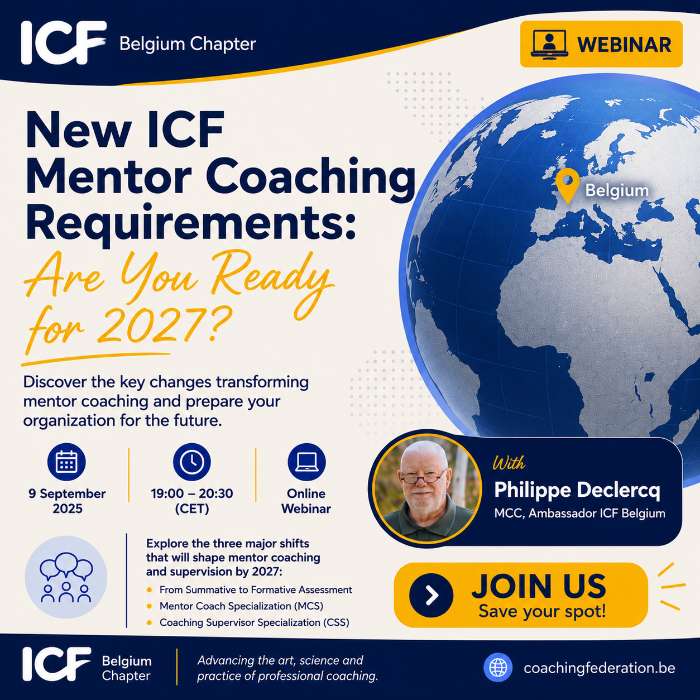 ICF Belgium
Virtual (meeting)
Gepresenteerd door Philippe Declercq MCC
Wanneer?
Op 9 sep 2026
Van 19:00 tot 20:30
Prijs
| Non-members | € 35,00 |
|---|---|
| Members | Gratis |