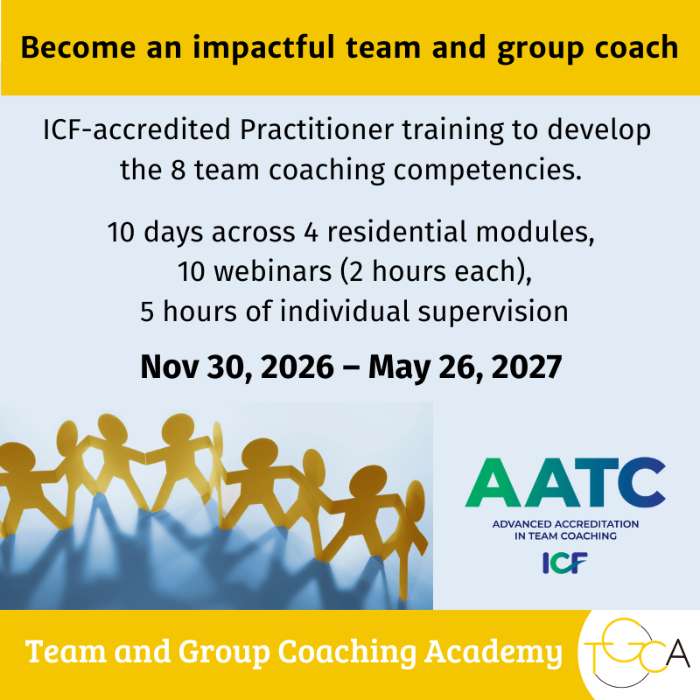
A comprehensive and structured program combining different learning formats: in-person residential modules and online sessions.
- 10 training days across 4 modules over 6 months (residential format encouraged to support immersion, but not mandatory)
- 5 webinars dedicated to theoretical input
- 3 Q&A sessions
- 2 peer co-development sessions
- 5 individual supervision and mentoring sessions
Practice is at the core of this program. From the very first module, participants coach, experiment and work on real or field-inspired situations. Extensive supervised practice allows for deep integration of learning and the development of strong professional reflexes.
Beyond tools, the program places a strong emphasis on the posture of the team coach: the ability to read what is happening within the system, to intervene with accuracy in complex situations, and to work with the “living dynamics” of the group, regardless of the models being used.
The program draws on a wide range of approaches and tools (systems thinking, Theory U, NLP, Transactional Analysis, collective intelligence, Spiral Dynamics, serious games…), while developing the ability not to rely on any single model.
It has been designed based on real situations observed in team coaching supervision, in order to address in a concrete way the most common pitfalls of the profession: role confusion, difficulty working with conflict, the tendency to over-facilitate, or to avoid sensitive dynamics.
This program enables you to develop the 8 team coaching competencies defined by the ICF and to earn up to 99 CCEU. It also supports your path towards the ACTC (Advanced Certification in Team Coaching).
Dates of upcoming training cycles
Next English-speaking cohort:
30 Nov – 1 Dec 2026
25–26 Feb 2027
12–13–14 Apr 2027
24–25–26 May 2027
You will find an overview of the program in this PDF document.
Next French-speaking cohort:
Module 1: 10–11 May 2027 – residential
Module 2: 28–29 June 2027 – residential
Module 3: 20–21–22 September 2027 – residential
Module 4: 18–19–20 October 2027 – residential
Vous trouverez un aperçu global de la formation dans ce document PDF.
The program takes place in Affligem, north of Brussels.
The residential format is strongly recommended to support immersion, but remains optional.
FOR WHOM:
This program is designed for professionals who want to develop a solid practice in team or group coaching:
- individual coaches wishing to expand their practice
- facilitators and consultants who want to integrate a coaching posture
- managers who want to develop a different way of supporting their teams
WHAT YOU WILL LEARN:
- Read what is happening within a group and adapt your intervention in real time
- Create and hold a space that enables deeper and more constructive interactions
- Build trust within a team
- Work with unspoken dynamics, tensions, conflicts and underlying patterns
- Strengthen team cohesion
- Stimulate collective creativity
- Increase team members’ engagement
- Manage and de-escalate tensions and conflicts in a constructive way
- Develop a genuine culture of collaboration
WHAT YOU WILL GAIN:
By the end of the program:
- You will feel confident facilitating team and group coaching
- You will know how to intervene in complex or dysfunctional team dynamics
- You will be able to embody a clear and appropriate team coaching posture
- You will be able to create impact without taking the leader’s role
- You will master approaches that enhance collective intelligence
- You will have practised across multiple formats: in-person, residential, online, small and large groups, co-facilitation, serious games, multicultural environments
- You will benefit from a rich and coherent set of approaches and tools
LEARNING APPROACH
Becoming a practitioner requires practice. This program is highly experiential and grounded in real-life application.
Most theoretical input is delivered through webinars and pre-reading materials, allowing in-person modules to focus on practice.
All modules are co-facilitated by at least two trainers, giving you direct exposure to co-facilitation.
Throughout the program, you will both experience and facilitate team and group coaching processes, during and between modules.
To support your implementation in real contexts, you will benefit from individual mentoring sessions with a supervisor-coach.
Potential subsidies
Self-employed professionals and companies based in the Brussels-Capital Region may benefit, under certain conditions, from training subsidies ranging from 40% to 70%. (Infos et Conditions).
 Coach Education
Présenté par Quynh Anh Trinh Xuan, (MCC), Sylvie Timmers (MCC) et Hugues Hancotte (PCC)
Quand ?
Du 30 nov. 2026 au 26 mai 2027
De 09:00 à 17:00
Où ?
Koningsteen VZW
Oxdonkstraat 168
1880 Kapelle-op-den-Bos
Belgium